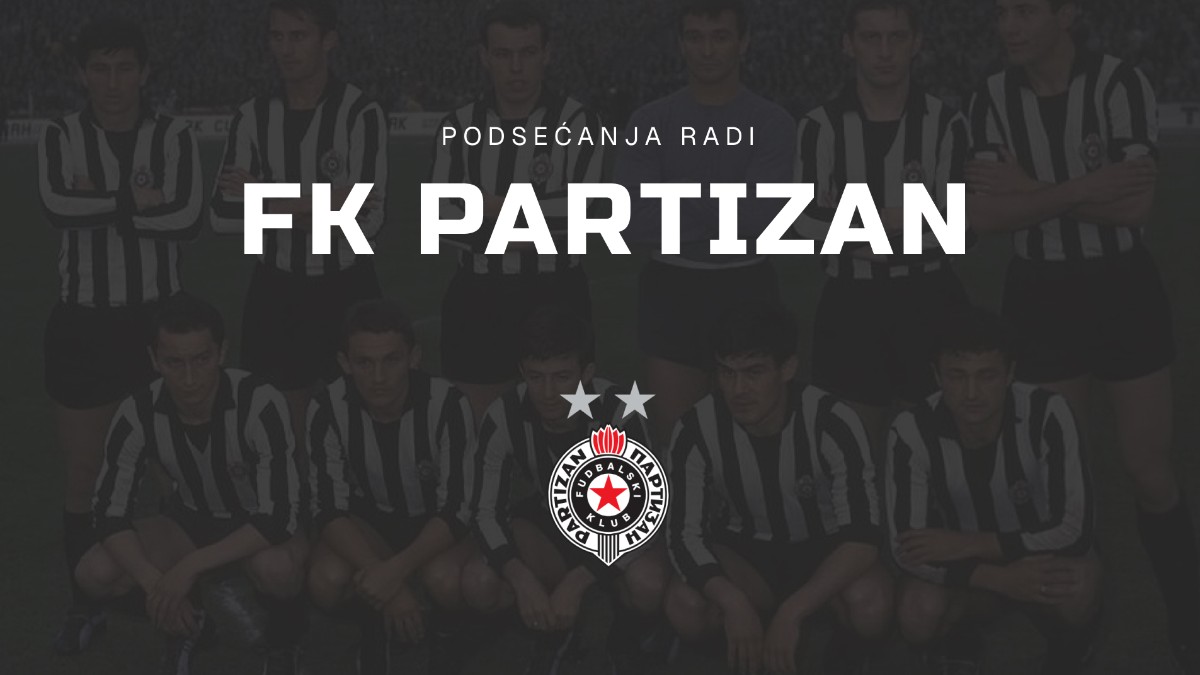
Football Club Partizan was founded on
October 4, 1945 in Belgrade, in the period immediately following the end of World War II.
It was established within the Central House of the Yugoslav Army as part of a sports association that soon brought together a large number of sports sections.
Among those involved in establishing the sports association were Svetozar Vukmanović Tempo, Peko Dapčević, Koča Popović, and other military and civic leaders of the time.
Ratko Čoče Vujović was elected the football club’s first president.
The first players to join the new club were mostly footballers who already had experience playing for well-known pre-war teams. Among them,
Stjepan Bobek stood out in particular; he would later become one of Partizan’s and Yugoslav football’s greatest legends.
Interestingly, Partizan played its first match just two days after its founding. It was on October 6, 1945, against the Zemun representative team. The black-and-whites won 4–2, and the team’s first coach was
Franjo Glazer.
From the very beginning, it was clear that a club with great sporting ambitions was taking shape. Partizan soon became one of the most successful football clubs in Yugoslavia, and its name began to be recognized beyond the country’s borders.
YEARS OF SUCCESS, TROPHIES, AND EUROPEAN RECOGNITIONPartizan achieved its first major results in its early years. It won its first Yugoslav championship title in the 1946/47 season, and also won the national cup that same year.
Over the following decades, the club continued to build its reputation. The 1960s, 1970s, and 1980s were particularly successful periods, when the black-and-whites won league titles and cups, while also producing generations of footballers who played an important role in international football.
According to the club’s official records, Partizan has won to date:
·
27 national league titles;
·
16 national cup trophies;
·
the Mitropa Cup, or Central European Cup, in 1978.The 1965/66 season holds a special place in the club’s history, when Partizan achieved the greatest European success in its history.
1966 – PARTIZAN AT THE PINNACLE OF EUROPEAN FOOTBALLOne of the most important chapters in the history of the black-and-whites was written on May 11, 1966, in Brussels. Partizan reached the European Cup final, the competition now known as the UEFA Champions League, where the mighty Real Madrid awaited them.
The road to the final was extremely challenging, and the Belgrade club showed it could compete with the best teams in Europe.
In the final, Partizan took the lead in the 55th minute with a goal from Velibor Vasović.
However, Real Madrid managed to turn the score around with goals from Amancio in the 70th minute and Serena in the 76th, and the match ended in a 2–1 victory for the Spanish club.
Although the trophy did not make it to Belgrade, reaching the final was a historic achievement. Partizan became the first club from the former Yugoslavia to reach the final of this prestigious European competition, and its name was forever etched in the history of European football.
The generation that achieved this success included
Milutin Šoškić, Fahrudin Jusufi, Velibor Vasović, Ivan Ćurković, Milan Galić, Vladica Kovačević, and many other footballers who left a deep mark on the club’s history.
Partizan has also achieved significant results in more recent European competitions. Particularly notable are its appearances in the UEFA Champions League group stage in the 2003/04 and 2010/11 seasons, as well as its many appearances in the UEFA Cup and Europa League.
HUMSKA – THE STADIUM WHERE GENERATIONS MADE HISTORYPartizan’s home is located at 1 Humska Street in Belgrade. The stadium was
opened on October 9, 1949, when it hosted a match between the national teams of Yugoslavia and France, which ended 1–1.
It was built on the site of the former pre-war BSK ground and was originally called
JNA Stadium. In its first decades, it could accommodate around 55,000 spectators, but its capacity was reduced after renovations and the installation of seats.
Today, the stadium is officially known as Partizan Stadium and, according to club information, has 29,775 seats. The pitch measures 105 x 68 metres.
Many matches that shaped the history of Yugoslav and Serbian football have been played at this very stadium. Generations of fans came to Humska to cheer on their favourites, celebrate trophies, and share in the joy of great victories.
For supporters of the black-and-whites, Humska is more than just a sports venue. It is a place where tradition is cherished and love for the club is passed down from one generation to the next.
THE GRAVEDIGGERS – FANS WHO ARE PART OF THE CLUB’S IDENTITYThroughout its history, Partizan has built a large and distinctive fan base, with its best-known supporters gathered under the name
Grobari.
The black-and-white supporters are known for their strong bond with the club, the atmosphere they create at the stadium, and their fierce rivalry with Red Star supporters.
The matches between the two Belgrade clubs, known as the Eternal Derby, are among the best-known sporting events in Serbia and the region. For decades, they have attracted widespread public attention and represent one of the most recognizable football rivalries in this part of Europe.
Partizan and its supporters share a long history, and the black-and-white colours have become an important part of the sporting identity of many people in Serbia and abroad.
LEGENDS WHO MADE PARTIZAN HISTORYWhen talking about Partizan’s history, it is impossible to overlook the many footballers who became part of the club’s history through their performances, goals, and trophies.
Stjepan Bobek undoubtedly holds a special place. One of the greatest footballers in the club’s history, Bobek is Partizan’s all-time leading scorer, with 425 goals.
His name will forever be associated with the first great generations of the black-and-whites.
Momčilo Vukotić was one of Partizan’s most recognizable footballers during the 1970s and 1980s. He played 791 matches for the first team and scored 339 goals. His loyalty to the club and footballing ability made him one of Humska’s greatest icons.
Velibor Vasović is remembered as captain of the team that reached the European Cup final in 1966. His goal against Real Madrid was one of the most significant moments in the club’s history.
Dragan Mance is one of the most beloved footballers in Partizan’s history and a symbol of a special generation of the black-and-whites. He was a fan favourite thanks to his goalscoring instinct, fighting spirit, and distinctive goal celebrations.
His life was tragically cut short when he was just 22, but the fans’ love and memories of his footballing talent have never faded.
In more recent history,
Saša Ilić holds a special place—a footballer who spent virtually his entire playing career in the black-and-white shirt. With 873 appearances, he holds Partizan’s record for most first-team appearances, and he won as many as 18 trophies with the club.
Other well-known names to have worn the Partizan shirt include
Predrag Mijatović, Savo Milošević, Mateja Kežman, Danko Lazović, Albert Nađ, and many others.
COACHES WHO LEFT A LASTING MARKThroughout the club’s history, great players have been guided by coaches whose knowledge, authority, and results contributed to Partizan’s development.
Franjo Glazer was the team’s first coach, and his name holds a special place in the club’s very beginnings.
One of the most significant coaches in more recent history is undoubtedly
Ljubiša Tumbaković, who led Partizan during his long tenure at Humska, a period of great domestic success. Under his leadership, the club won several league and cup trophies and developed a strong competitive identity.
Lothar Matthäus, a German football coach and former world champion, also holds a special place. In 2003, he led Partizan to the club’s historic qualification for the Champions League group stage.
THE YOUTH ACADEMY – ONE OF PARTIZAN’S GREATEST ASSETSFor our AFT platform, a particularly interesting part of Partizan’s story is its work with young footballers.
For decades, Partizan’s youth academy has been one of the most important foundations of the club’s identity.
Throughout its history, the club has paid particular attention to identifying and developing young talent, and many players who went on to enjoy major international careers took their first serious steps in football in the black-and-white ranks.
Ilješ Špic, a coach whose football philosophy laid the foundations for organized work with young players, was one of the key figures in the development of Partizan’s academy.
Well-known footballers who came through Partizan’s youth academy include:
· Savo Milošević;· Saša Ilić;· Aleksandar Mitrović;· Dušan Vlahović;· Stevan Jovetić.These footballers represent just a few of the generations who progressed through Partizan’s system to the senior national team and the international stage.
It is especially significant that the club sees its youth academy not just as a place to produce future first-team players, but as a long-term project requiring quality coaches, infrastructure, systematic work, and the right conditions for children to develop.
PARTIZAN–TELEOPTIK: A CENTRE FOR DEVELOPING NEW GENERATIONSThe Partizan–Teleoptik Sports Centre,
opened in May 1998 in Zemun, plays an important role in working with young footballers.
The complex covers ten hectares and is the main training venue for all of Partizan’s age groups, from the youngest teams to the first team. FK Teleoptik, Partizan’s official affiliate club, also trains at the centre.
The sports centre has seven football pitches, four with natural grass and three with artificial turf. The complex also includes changing rooms, a gym, a medical centre, recovery facilities, and other amenities needed for daily training.
Notably, Partizan completed the modernization of the sports centre during 2025, improving conditions for all its teams.
Another important step was taken in October 2026, when construction began on a new boarding facility for young footballers.
According to the published plans, the first phase provides for 20 apartments accommodating 45 young players, along with classrooms, a dining hall, and communal areas.
This project shows that Partizan continues to invest in the future of its youth academy and in creating conditions where young footballers can develop not only as athletes, but also through education and everyday life.
PARTIZAN AND AFT – THREE SEASONS AMONG THE MOST SUCCESSFUL!A particularly interesting part of FK Partizan’s recent story concerns its results in AFT competitions.
Over the past three seasons, the black-and-whites have shown outstanding commitment to competing in AFT tournaments, and their results have placed them among the very best in international competition.
Their sustained success is best illustrated by the figures from three competitive seasons:
·
2024/25. – Partizan earned a total of 1,005 AFT points and finished the season in second place among the most successful clubs in the AFT system.
·
2025/26. – the black-and-whites took another big step forward, collecting 2,000 AFT points and finishing in first place as the season’s most successful club.
·
2026/27. – in the current season, Partizan has earned 830 AFT points so far, which currently puts it in third place in the rankings.
These results say much more than the numbers alone. Second place, followed by a first-place finish, and then the current third-place position show that Partizan has belonged among the very best in the AFT competition system for several seasons now.
The achievement in the 2025/26 season is particularly impressive, when the black-and-whites were the most successful club in AFT competition with 2,000 points.
This result confirms the quality of the work with the younger age groups, as well as the breadth of the club’s system, which enables many generations to compete.
AFT is delighted that one of the region’s best-known football clubs contributes to the quality and international character of our competitions through its participation.
At the same time, Partizan’s results are an excellent example of how success on the international stage can be built through consistent participation, work with young footballers, and sporting competition.
There is still part of the 2026/27 season ahead, and the battle for the best possible positions in the AFT rankings continues. Partizan has already shown that it belongs among the leading clubs in our system; now we will have to wait and see whether it can reach the very top again as the season continues.
 AFT Srbija
Podsećanja radi...